

International Co.,Ltd. (TCI) specializes in manufacturing and exporting insulators, power fittings, bushings, cables and accessories for power transmission lines and substations. In addition to supplying high-quality products to our customers, we also provide superior technical assistance and services to meet their various needs.


Why Choose Us
Rich Experience
More than 70% of TCI's staff has bachelor degrees or higher. Many senior engineers and technicians are knowledgeable and experienced in the fields of high voltage, macromolecule research and machine manufacturing. We also have a well-established skilled workforce.
Professional Team
We has the complete management and technology teams, modern office facilities and business management software guaranteeing our clients secure operation solutions and sustainable business models.
Our Certifications
We implement the ISO 9001:2015 Quality Control and the ISO14001:2015 environmental management systems.
Our Market
TCI's products have been exported to 100 countries in the world. Our high quality products and services have helped us to obtain overseas market share and good reputation.
Overview of Composite Insulator
Insulators are critical components in the power transmission and distribution (T&D) industry. They serve to electrically insulate live parts of electrical systems from each other and from the ground, ensuring the safe and efficient flow of power. The role of composite insulators extends beyond mere insulation. They are designed to withstand various environmental conditions, such as UV radiation, extreme temperatures, and mechanical stress. Their importance lies in their ability to prevent electrical leakage, reduce maintenance costs, and enhance the reliability of power systems.
Advantages of Composite Suspension Insulator
Mechanical Strength
They are designed to withstand high mechanical loads, including wind and ice, making them suitable for various environmental conditions.
01
Flexibility
Suspension insulators can accommodate movement and sag in the power lines, which helps maintain the integrity of the line under varying loads.
02
High Voltage Capability
They are effective at insulating high voltage lines, preventing electrical arcing and ensuring safety.
03
Durability
Made from materials like porcelain or glass, suspension insulators are resistant to weathering and can last for many years with minimal maintenance.
04
Easy Installation and Replacement
The design allows for straightforward installation and replacement, which can reduce downtime during maintenance.
05
We offer the following Product Specifications
|
Type of Insulator |
FXBW-500/(420/400) |
FXBW-500/(550/530) |
|
Specified Voltage |
500 kV |
500 kV |
|
Specified Mechanical Tensile Load |
420/400 kN |
550/530 kN |
|
Connection Structure Mark |
28 |
32 |
|
Section Length |
4450±50 mm |
4450±50 mm |
|
Min. Arcing Distance |
4000 mm |
4000 mm |
|
Big shed Diameter |
190 mm |
218 mm |
|
Diameter of Grading Ring |
350/370 400 mm |
350/370 400 mm |
|
Diameter of Grading Ring |
370/400 mm |
370/400 mm |
|
Min. nominal Creepage Distance |
14000 mm |
14000 mm |
|
Lightning Impulse Withstand Voltage(peak value) |
≥2250 kV |
≥2250 kV |
|
Operating Impulse withstand Voltage(Peak) |
≥1240 kV |
≥1240 kV |
|
Power Frequency WithstandVoltage Min.Wet(RMS) |
≥740 kV |
≥740 kV |
|
Reference Weight |
33 kg |
34 kg |
Types of Composite Suspension Insulator
Composite long rod insulators
Composite long rod insulators are primarily used in suspension strings in straight-line supports and as tension strings in anchor towers and dead-end towers. They are also used in the jumpers or portals of outdoor substations. In some cases, composite long rods are used in the guys of wooden poles, and more rarely in the guys of steel towers.
Composite post insulators
In contrast to composite long rods, composite post insulators are subjected mainly to loads which act perpendicular to the longitudinal axis of the insulator and thus produce bending stresses over the cross-section of the insulator. As a result of this bending load, composite post insulators use FRP rods of substantially greater diameter compared to composite long rods. Typical applications of composite post insulators include distribution insulators, vertical and horizontal line posts, busbar support insulators and railway catenary insulators.
Composite hollow core insulators
Composite hollow core insulators (referred to hereinafter as HCI for short) are used primarily as housings for various high-voltage equipment and apparatus. Owing to their conditions for use, they primarily have to withstand bending and compression loads and since a large number of the electrical equipment are gas insulated (with SF6 and SF6 gas mixtures), they are also subject to internal pressure. Today, if the user so desires, it is possible to design complete substations in silicone composite technology.


Composite Polymer insulators consists of three parts: FRP( Fiber Reinforced Plastic) rod, silicon rubber umbrella , and galvanzied fittings.
Silicone rubber shed adopts an integral injection molding process.This process will solve the key problem (interface electrical breakdown)that affects the reliability of polymer insulator.
Our factory adopts the most advanced crimping technology to assemble FRP rod and fitting.This technology is equipped with a fully automatic sonic flaw detection system. Helping us to make high strength, beautiful appearance, small size and light weight product.
Galvanized metal fittings can prevent rust.All metal fittings adopt the international standard of galvanzied: ASTM A 153.
Composite Polymer insulator can interact with porcelain insulator. It has reliable structure.so that not easy to damage FRP rod. And it can give full play to its mechanical strength.
The installation of suspension insulator strings should meet the following requirements:
Except for design reasons, the suspended insulator string should be vertical to the ground. When conditions cannot meet the requirements, the inclination angle may not exceed 5°.
When multiple strings of insulators are connected in parallel, the tension on each string should be uniform.
When assembling insulator strings, the bolts, pins and locking pins of the connecting hardware must comply with current national standards and be complete. Their threading directions should be consistent. The bowl mouth of the tensile insulator string should be upward, and the ball head of the insulator string should be hung The ring, bowl head hanging plate and locking pin should match each other.
The spring pin should be elastic enough, and the closing pin must be separated and must not be broken or cracked. It is strictly forbidden to use wire instead.
Protective hardware such as voltage equalizing rings and shielding rings should be installed firmly and positioned correctly.
Insulator strings should be wiped clean before lifting.
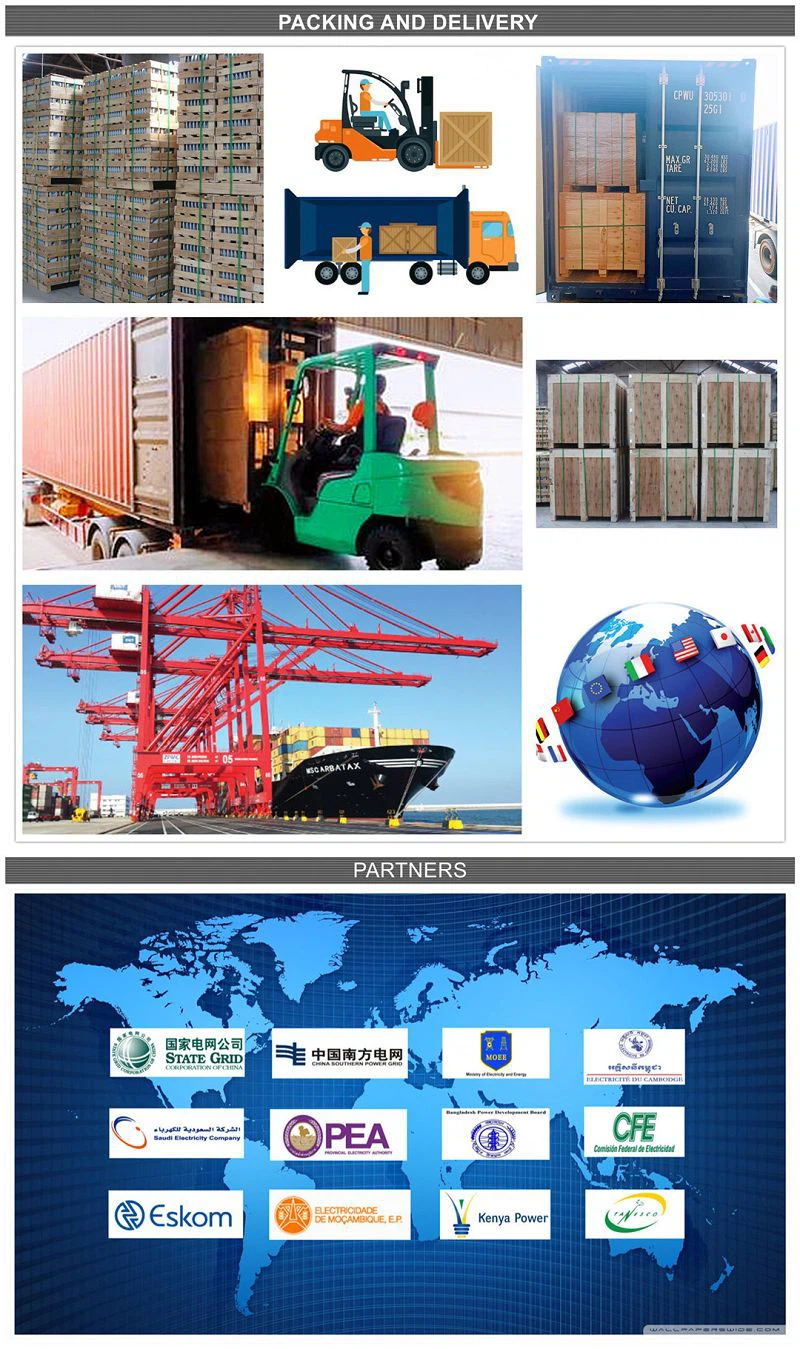
Packaging & Delivery
Certifications

FAQ
As one of the most professional composite suspension insulator manufacturers and suppliers in China, we're featured by quality products and good service. Please rest assured to buy customized composite suspension insulator made in China here from our factory.
Tension Insulator For Transmission, 10kv Polymer Suspension Insulator, 500kv Polymer Suspension Insulator