

Why Choose Us?
Advanced Equipment
Our Factory is well equipped with all worldclass facilities, such as programmable tensile load testers, crimping systems with acoustic emission detectors, fully automated rubber injection moulding machines, vulcanization testers, a complete set of power frequency transformers and impulse voltage generators.
Wide Product Range
Main products include composite insulators for electric power lines from 10 to 800kV, composite insulators for electric railways, phase spacers, disconnecting switches, bushings, surge arrestors, etc. Our products have a good reputation in international markets.
Complete Qualifications
We implemented the ISO 9001:2015 Quality Control and the ISO14001:2015 environmental management systems. DCI's management and comprehensiv ecompetitiveness, quality of products and services, benefited enormously.
Broad Market
DCI's products have been exported to Europe, America, Oceania, Africa and Asia. We also have long-term cooperation with a lot of large international electricity companies like TYCO, ABB, AREVA, ALSTOM, PLP, Victor, EB, NTP and Siemens.
The glass insulators usually are manufactured at high temperatures by mixing the different materials, including lime and quartz powder, and then it suddenly cools in the mold. This action ("Toughening" causes tightening of the glass). In this way, a glass insulator is obtained.
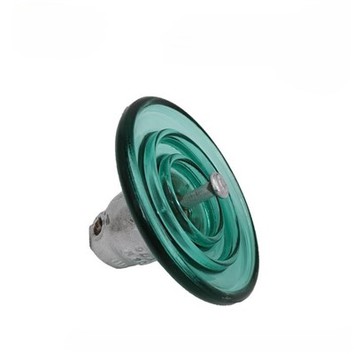


Benefits of Glass Insulator
Compared with porcelain, it has high dielectric strength.
Its resistivity is also high.
It has a low thermal expansion coefficient.
Compared with porcelain insulators, it has higher tensile strength.
Since it is transparent, it will not heat in sunlight like porcelain.
Due to its transparency, impurities and air bubbles can be easily detected inside the glass insulator.
Glass has a very long service life because the mechanical and electrical properties of glass are not affected by aging.
Glass is cheaper than porcelain.
Materials of Glass Insulators
Insulators are made of ceramic materials which include porcelain and glass. Their initial use precedes the construction of power systems. They were first introduced as components in telegraph networks in the late 1800s.
There are a number of basic designs for ceramic insulators. Porcelain is used for the production of cap and pin suspension units, solid and hollow core posts, pin type, multi-cone and long rod insulators, and bushing housings. Glass, on the other hand, is used only for cap and pin suspension and multi-cone posts. Porcelain and glass insulators are well established, as might be expected based on their long history of use. Currently these types of insulators comprise by far the majority of in-service units. Continuous improvements in design and manufacturing processes have resulted in insulators, which are both reliable and long lasting. Porcelain units are coated with a glaze to impart strength to the surface. Today's glass insulators are predominantly manufactured from thermally toughened glass, which prevents crack formation. Both of the materials have inert surfaces, which show very good resistance to surface arcing, and both are extremely strong in compression.
The manufacturing process for electrical porcelain is complex and involves numerous steps. With glass insulators, the manufacturing process is less complex, but still requires tight control. Failures of porcelain and glass insulators can usually be traced back to the manufacture, material or application of the units. If adequate caution and control in these areas is not maintained, the likelihood of an inferior product increases. However, as previously mentioned, when well made, both porcelain and glass insulators are highly reliable. The majority of bushings and lightning arresters installed in today's substations are contained within porcelain housings. Porcelain housings are, in essence, hollow core post insulators.
How Does Contamination Affect the Performance of High-Voltage Glass Insulators?
Contamination, such as the accumulation of salts, dust, or other natural or artificial elements, combined with moisture on the surface of glass insulators, can significantly affect their performance and effectiveness. This contamination can lead to a decrease in the dielectric strength of the insulator chain, increasing the risk of electrical arcs and shocks.
On the other hand, excessive contamination without taking mitigation measures can potentially accelerate the aging of insulators due to corrosion.

The Critical lmportance of Glass Insulators
Safety and Protection
Glass insulators significantly reduce the risk of accidents, such as electrical shocks andshort circuits, which can lead to power outages or fires, by insulating electrical wires. They also protect the electrical system from environmental threats, including wateringress, which can cause serious damage and lead to dangerous failures.
Efficiency and Reliability
Glass insulators ensure the efficient transmission of electricity by preventing leakage ofcurrent. This efficiency is essential for minimizing energy loss across vast electrical networks. They contribute to the reliability of electrical systems by maintaining uninterrupted power supply and reducing the freguency of maintenance and repairs caused by insulation failure.
What Are Glass Insulators Made out Of?
Most insulators in the U.S. were made of glass or porcelain. There are some composite, gutta-percha, rubber, and even wooden insulators. I will be speaking primarily about glass insulators since they are my specialty (with the exception of very early telegraph insulators which were made of various materials including porcelain).
Materials
Telegraph insulators made out of glass, gutta percha, composition, wood, metal, and one of the earliest plastics ever made.
Ramshorns
Very early ramshorn type insulators. The ramshorn itself is iron. They are set in glass, gutta percha, rubber, and composition.
Porcelain threadless
A very rare and diverse collection of threadless insulators made out of porcelain.

Notes on the CD Numbering System:
CDs 100-144 Have a side wire groove and no inner skirts
CDs 145-184 have side wire grooves and one inner skirt
CDs 185-188 are through pinhole styles
CDs 185-205 are Transposition styles
CDs 206-249 are saddle groove styles with an inner skirt
CDs 250-279 are cable style insulators
CDs 280-289 are side groove styles with two inner skirts
CDs 290-309 are top groove styles with two inner skirts
CDs 315-333 are power insulators with umbrella skirts
CDs 335-375 are multipart cemented power insulators
Why Are Glass Insulators Green?
The basic material of glass is quartz sand. Tomelt this sand at a lower temperature than would otherwise be required, a variety of“fluxing' materials is used in combination with the sand. Both borax and soda ash are used to lower the point of melting, while other ingredients are added to stablize the glass that may be exposed to extremes in temperature upon installation. A glass product, in its natural state, is green in color due to the iron content in the quartz sand used in its manufacture. Various decolorizing agents can be added to the batch to remove the impurities and the green color in the glass.
Prior to World War I, manganese was readily available and used as the agent to clear the glass. Some "clear"end-product insulators manufactured using the manganese agent turned to a light purple color following manufacture or when exposed to sunlight over a period of time. These chemical phenomena should not be confused with the insulators that were purposefully manufactured with enough manganese so as to initally color the glass purple. Selenium used as the agent would turn a straw or a yellow color.
Why Are Some Glass Insulators Purple?
Purple coloring in insulators is caused by the addition of manganese, a de-colorizer originally used to remove the green or aqua cast caused by the iron inevitably found in batch sand (all glass colorants are metals or metal oxides).
After exposure to radiation-- either natural solar or artificial-- the manganese ionizes to a purple form; the more manganese, the darker the purple eventually becomes. If too much manganese is added initially, the glass starts out purple, then turns darker still, hence "royal purple". The manganese used in insulator production once came mostly from Germany. When World War I broke out, the supply was cut off, and selenium was used instead. Selenium glass also "solarizes", but turns a straw color.

International Co.,Limited was established in 1996 which focuses on electric products, marketing, services and logistics. It is an important manufacturer and export trader with several decades of experience in designing, researching, manufacturing, testing and logistics. TCI, located in , with the largest port in North-East of China, has strong capacity of technological research and development.
More than 70% of TCI's staff has bachelor degrees or higher. Many senior engineers and technicians are knowledgeable and experienced in the fields of high voltage, macromolecule research and machine manufacturing. We also have a well-established skilled workforce. We have a long-time close relationship with the China Electric Power Research Institute, CESI, all supporting our technological research and development.
We implement the ISO 9001:2015 Quality Control and the ISO14001:2015 environmental management systems. TCI's experience in this competitive market has formulated a well regulated management style for product sales, quality and services.
Ultimate FAQ Guide to Composite Insulator
As one of the most professional glass insulator manufacturers and suppliers in China, we're featured by quality products and good service. Please rest assured to buy customized glass insulator made in China here from our factory.